Measles was declared eliminated from the United States in 2000. On November 13, 2026, the Pan American Health Organization (PAHO) confirmed what public health officials had long seen coming: the United States had lost that status, becoming the latest country in the Americas to see measles return as an endemic health threat. Canada lost its elimination status earlier in the year, with similar underlying drivers.
“The PAHO announcement is a confirmation of the reality we’ve all been living,” says Caitlin Rivers, an infectious disease epidemiologist who leads the Center for Outbreak Response Innovation at Johns Hopkins University. “What it confirms is that measles has returned, and that the work of containing it falls, as it always has, on the health departments, epidemiologists and preparedness staff working county by county, outbreak by outbreak, family by family.”
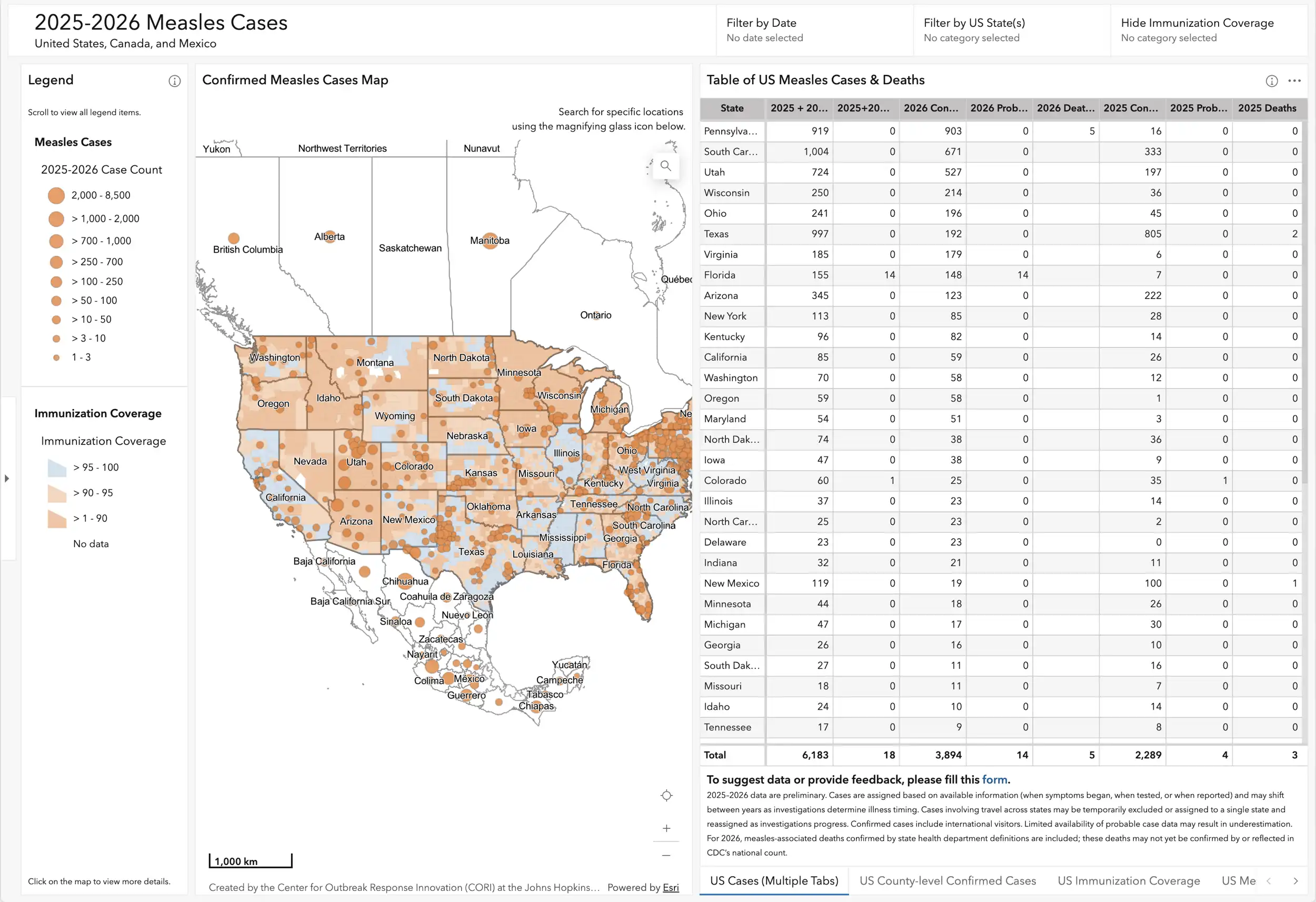
The Center works with state and local health departments to make outbreak responses faster, more effective and less improvised. Rivers and her team have developed practical resources to support health departments facing measles cases and created a dashboard to track cases, public exposure notices and vaccination coverage. The Center also collaborates with Resolve to Save Lives, anchored by a shared conviction that the 7-1-7 target fills a long-standing gap in U.S. public health: strong process metrics for outbreak response.
The Center for Outbreak Response Innovation’s measles dashboard.
Against a challenging national backdrop, some U.S. jurisdictions are beating the trend. In Pima County, Arizona, Mecklenburg County, North Carolina and Tennessee, public health teams have moved fast, kept case counts low and stopped outbreaks before they spiraled into larger problems. “Getting outbreaks under control is impressive,” says Rivers. “The longer one goes on, the harder it becomes to contain. That effort deserves recognition.”
Across all three jurisdictions, three factors stood out:
Readiness
Strong outbreak response often begins before the outbreak arrives. The jurisdictions featured were monitoring neighboring states, joining multistate calls and strengthening their systems and relationships in the months before their first local case.
Timeliness
Speed saves lives in measles response. These jurisdictions have embedded the 7-1-7 target, which sets standards for how quickly health departments should detect, notify and respond to an outbreak, into their everyday operations.
Relationships
The jurisdictions doing well invest in relationships between teams, organizations and the communities they serve. Those connections are what allow a vaccine clinic to stand up quickly and a hesitant family to open their door.
Learn more about each jurisdiction’s response and how it incorporated the 7-1-7 target, using the tabs below.
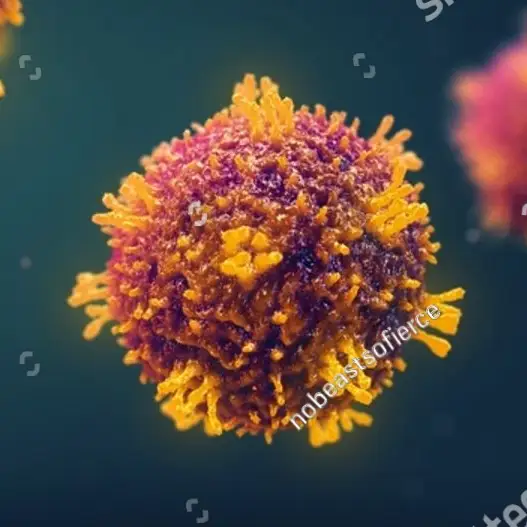
The measles virus. Credit: Shutterstock
Pima County, Arizona
What happened
The first measles case in Pima County occurred in a traveler returning from abroad. Credit: Shutterstock
On January 13, 2026, a fully vaccinated traveler returning from abroad developed a rash consistent with measles. The following day, a call came into Pima County’s Disease Reporting Line and was routed to an epidemiologist. Within 24 hours, the relevant public health teams had been notified, and by January 15, the county health department had activated its Incident Command System to coordinate a response.
The response
When the index case was confirmed, Pima’s Chief Medical Officer moved quickly to connect with the health facility where the traveler presented symptoms. Around 110 contacts were traced and monitored. Within days, a vaccine clinic was running outside regular business hours at El Rio Health Congress, a medical center in Tucson, and publicized to residents so they knew where to go. By January 17, just four days after the first case was detected, the health department had completed all its early response actions.
A second case emerged on January 22 and set off the response’s most intense moment. An unvaccinated healthcare worker with direct exposure to the index case developed symptoms. She had since worked in a pediatric setting, and a subgroup of infants, too young to be vaccinated, had been exposed. The team identified 9 such infants, coordinated with state partners and arranged for immunoglobulin to be delivered to El Rio. That night, the team spent hours calling each family to bring their child in the next morning. All the families agreed and all the infants received immunoglobulin. None of them developed measles.
Eleana Acosta Zavala, one of the epidemiologists who participated in the response, pointed to two factors critical to Pima’s successful response. “Our leadership has invested in relationships with their counterparts at other organizations long before the outbreak, rather than scrambling to meet people once it had started,” said Acosta Zavala. “We’ve also invested heavily and consistently in maintaining vaccination rates and tracking timeliness metrics.”
Use of 7-1-7
Pima County has been using the 7-1-7 target for around four years, embedding it into outbreak response work that began during COVID-19 and has continued since. “The 7-1-7 target creates space for action items that lead to creative solutions,” said Acosta Zavala. Since January’s outbreak, the team has already put lessons into action: when another measles case arrived in the spring, they stood up a contact tracing call center within a single day, something that had taken considerably longer in previous outbreaks.
Mecklenburg County, North Carolina
What happened
From 2019 through 2023, North Carolina recorded zero measles cases. One appeared in fall 2024, then another in the summer of 2025. By January 2026, the context had shifted dramatically: neighboring South Carolina was experiencing what was, at the time, the largest measles outbreak in recent U.S. history. And Charlotte’s Mecklenburg County, a major city with deep connections to communities across state lines, was directly in its path.
A technician at a wastewater treatment plant. Mecklenburg detected measles virus at a treatment facility before the first case was confirmed. Credit: Shutterstock
The first sign that measles had arrived in Mecklenburg came from the county’s wastewater. Routine surveillance at the Sugar Creek wastewater treatment plant detected the measles virus in January 2026, before a single case had been reported. By January 23, two cases had been confirmed: an adult who had been in contact with a confirmed measles case through travel, and an unvaccinated child with a direct link to the outbreak in South Carolina.
The response
Mecklenburg’s response started six months before those first cases arrived. Paige Bennett, Deputy Director of Mecklenburg County Public Health, had been joining weekly calls to track the South Carolina outbreak as it grew. “During that time, our team built relationships with our counterparts in South Carolina,” said Bennett. “We also started working on a new case management system to support contact tracing and expedited vaccination of children who hadn’t yet completed their series.”
When measles appeared in Mecklenburg’s wastewater, the team was ready. Health officials immediately opened walk-in vaccine clinics, before the first cases were confirmed. Once confirmation came, the department activated its Incident Command System and investigators began working through the exposure lists, cross-referencing names against the state immunization registry to identify who was unvaccinated.
For high-risk contacts who lacked protection, the team coordinated with local hospitals to arrange immunoglobulin administration. Public exposure notices went out to affected communities, including event sites, and communications staff fielded questions from residents about what exposure meant, what isolation required and how to get vaccinated.
A third case in an unvaccinated child who lived in Mecklenburg but attended school in neighboring Union County was confirmed on January 27 and handled in close coordination with Union County Public Health. Mecklenburg ended up with 3 confirmed cases and no deaths. By early February, the immediate response was over.
Use of 7-1-7
“For our team, 7-1-7 functions as a quality improvement tool as much as an outbreak metric,” said Bennett. The target has been embedded into her team’s infectious disease plan, and the after-action review that followed the measles outbreak gave the communicable disease team a reason to connect with community health educators, who previously worked in isolation. “Those relationships can make or break a response effort,” notes Bennett. “They didn’t exist before. And now that they do, they’ll long outlast this particular outbreak.”
Tennessee
What happened
During the week of August 17, 2026, staff at a local health department in East Tennessee noticed something unusual: multiple unvaccinated families from the same community were coming in to seek measles vaccination. During conversations with health department staff, community members shared information about friends and neighbors who had been exposed or were sick. By the week of August 24, three cases had been confirmed, all linked to an out-of-state gathering where at least one infected person had been present.
The response
A week before families started turning up at the health department’s waiting room, health officials in neighboring Kentucky had shared unconfirmed reports of a potential outbreak on a routine multistate call, which Tennessee health department staff had joined. When Kentucky formally announced its outbreak a few days later, the Tennessee team immediately shared that information with public health staff and healthcare providers in the affected border areas. Staff were already on high alert when the first families walked through the door.
Staff in Tennessee border areas were on high alert thanks to partnerships with health officials in neighboring Kentucky. Credit: Shutterstock
From there, the response moved quickly. Local and regional staff conducted home visits and community visits, allowing active case finding, vaccination outreach and relationship building at the same time. The health department activated its Incident Command System, bringing together communicable disease and preparedness staff from multiple regions along with laboratory, communications and healthcare-associated infections staff. A community vaccination clinic was set up, and more than 100 contacts were traced, while support was provided to quarantining families.
The pairing of disease expertise and preparedness experience is unusual in U.S. public health, but it’s built into how Tennessee operates. “The two teams sit in the same division and can function side by side when an Incident Command System activates,” said Dr. Mary-Margaret Fill, Tennessee’s state epidemiologist. “The result is a much more effective response effort.”
The success of the response is also attributed to building trust with communities that don’t proactively seek medical care unless they really need it. Part of Tennessee’s response depended on efforts from health officials and nurses building the rapport that made community outreach possible. “In a community that is deeply private, but not opposed to vaccination, empathetic communication makes all the difference,” said Dr. Fill.
“Building real relationships through a consistent presence and demonstrating respect for this community’s privacy and autonomy were our priorities,” according to one health department nurse. The efforts of these local staff were critical to the success of this response and may prove fruitful in responding to this community’s health needs in the future.
Three more cases appeared the week of September 7, all household contacts of one of the initial cases, bringing the total to six. While the outbreak is ongoing, the team anticipates the outbreak stopping with these six cases as they move through the incubation period.
Use of 7-1-7
Tennessee began incorporating 7-1-7 into outbreak reporting requirements in 2024, building the metrics into its existing REDCap data system rather than creating an additional data form for field staff to fill out. Bottleneck and enabler analysis followed in a second phase. “For field staff, applying 7-1-7 never felt like a new thing, which is why it was easy to make it the norm,” said an epidemiologist working at the Tennessee Department of Health who helped build 7-1-7 into the state’s routine operations. “We now have a team of ‘timeliness champions’ who think less about hitting specific numbers and more about timeliness as a value embedded in how they work.”
The experiences of Pima County, Mecklenburg County and Tennessee point to something bigger than three local successes. High-performing outbreak response requires the ability to anticipate threats, move information quickly, mobilize across institutional boundaries and build enough community trust to act, then learn from each event to do it better next time. In a country that has just lost its measles elimination status, that kind of capacity has never mattered more.